Paul Wilson, managing director of the Bristol Is Open project, explains how new forms of digital technology are being used to develop Bristol and position it at the vanguard of the smart city movement
The ability to see the ‘big picture’ is a desirable trait, and a smart one, but turning big-picture thinking into practice is no small task. Different disciplines speak different languages, and organisational boundaries come with different reward systems and timescales. Getting along well with each other also takes practice and patience, and is a necessary part of addressing the big issues of our day.
As we tackle modern-day issues, strong leadership needs to prevail over timidity, and nowhere is this more applicable and evident than in the urban context. In a bold move, the leaders of Bristol’s two largest institutions – its council and university – have chosen to address the challenge of building a smart city by creating a joint-venture company. It is tasked with working out both the ‘how’ and ‘why’ of the smart city. The foundation of the venture is innovating in digital connectivity; working with other partners to build a smarter, greener, more efficient city; and engaging with the city’s inhabitants. Bristol’s former directly elected mayor, George Ferguson, describes the city as “a laboratory for urban change”.
New forms of digital connectivity
Demand for connectivity is outstripping supply in many places. Smartphone users and the nascent Internet of Things (IoT) are forcing the worlds of internet, computing and centralised telecommunications to deliver more. Bristol Is Open’s chief technology officer, Dimitra Simeonidou, who is also professor of high-performance networks at the University of Bristol, believes that software-defined networks are the best way to deliver such heterogeneous and ubiquitous connectivity, with standards such as Stanford University’s OpenFlow and Linux OpenDaylight platforms accelerating progress.
“New forms of software-controlled digital networks will emerge over the next decade, ushering in a new wave of connected innovation,” Simeonidou predicts. “Handheld devices, connected by hodgepodge ‘het-nets’ [heterogeneous networks], will soon be able to receive and transmit a gigabit per second. This will revolutionise mobile computing again. New ways of distributing media and connecting ‘thing-to-thing’ autonomous systems will become mainstream.”
Bristol Is Open operates its own city-scale research-and-development communications network, set up to enable and explore many of these innovations. “We use dedicated digital infrastructure, funded by the Department for Culture, Media and Sport, to trial and test new forms of software-defined, heterogeneous connectivity,” says Simeonidou.
New 144-core fibre has been laid in ducts owned by the council, to connect four optical nodes with strategic local host partners – At-Bristol, Engine Shed, and Watershed – with a dozen more nodes on their way. The optical fibre provides powerful backhaul to a self-guiding, self-healing mesh network that covers more than 90% of the city, based on 1,500 lampposts. It also backhauls a wireless mile of connectivity created along Bristol’s Harbourside in the centre of town, to trial established and new forms of wireless connectivity, including 5G, massive MIMO (multiple input, multiple output) and even Li-Fi (Light Fidelity). “The vision is to get the whole environment controllable in software, and to enable network-function virtualisation in a technology-agnostic network that works at city scale,” says Simeonidou. “This will create the ubiquitous connectivity that the programmable city of the future needs.”
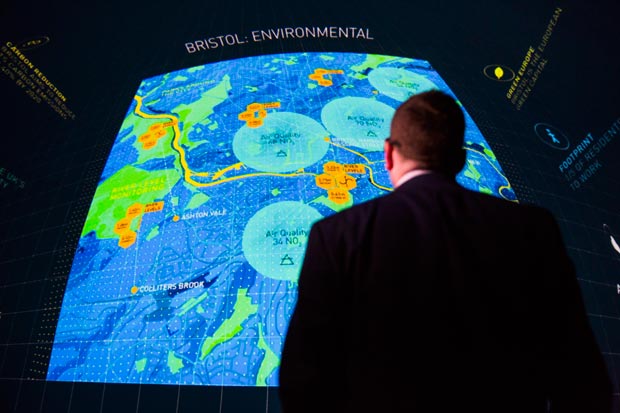
The city’s 100-seater planetarium in At-Bristol has been upgraded with 4K projectors, meaning it can present 2.1 billion pixels per second, creating the UK’s highest-definition display environment. The Bristol Data Dome is connected to the fibre network, which is in turn connected to a high-performance computing environment at the University of Bristol. It has created an unparalleled ability to visualise big data and city data in an immersive environment.
The next step is extending the digital infrastructure across the Bristol city region, connecting four universities, four local authorities and a population of 1.1 million people. The population includes 60,000 digital professionals – the largest number in the UK outside of London.
City-scale environmentalism
In 2015, Bristol became Europe’s Green Capital – the first UK city to receive the honour. Stephen Hilton, director of futures at Bristol City Council and Bristol Is Open’s director of city experimentation, helped guide the path to victory.
“Bristol is known for its community-led environmental activism and the Bristol Green Capital Partnership has more than 800 organisational members, creating a truly decentralised, bottom-up approach to environmentalism in the city,” says Hilton. “It was only relatively recently that the council took on more of a leadership role. After winning the honour of Green Capital in 2015, it launched the Bristol Energy company, the UK’s first municipal renewable energy company, and the Bristol Waste company. But it is the grassroots activism that drives the city forwards.”
Digitisation has a part to play in helping cities manage their environmental footprint. This is why Bristol Is Open is in discussion with two well-known eco-friendly organisations regarding the use of digital technology to quantify environmental factors at city scale; it is joined-up thinking that is becoming joined-up practice – a rite of passage for any city.
Pulling it all together
The task of bringing digital, environmental and urban experts together is tough and breaks new ground for everyone, but a relatively small city such as Bristol is a good place to start. The heart of the city is home to 600,000 people, a vibrant art, music and food scene, as well as talent from around the world. The sense of shared culture and shared adventure is fuelling the desire to address pressing global issues.
Hard-coding this into a joint-venture company and bringing together long-term industry partners is turning big-picture thinking into big-picture action. This approach is producing the much-needed laboratory for urban change and, as it develops further, it will be usable by many people, companies and governments, bringing about meaningful international impact.
Bristol’s smart city projects
Bristol prides itself on its use of smart city technology, not just for discrete operational efficiency purposes, but also to improve and enrich the lives of its residents. “We’ve got a programme called Playable City and another on citizen sensing,” explains Stephen Hilton, director of Bristol Futures. These are both designed to make living in Bristol a better, more interesting and surprising experience.
Playable City, for example, runs an annual competition to find schemes to make Bristol more interactive and engaging for the people passing through and living there. Winning contributions have included a project to record people’s shadows and then play them back on the street after they are gone. Another winner created computer images of rabbits, dolphins and kangaroos that interacted with people as they passed by.
Citizen sensing is a scheme to encourage residents to develop their own sensor-based apps to address local issues that they are passionate about. So far, this has led to mobile apps that deal with partner violence in teenage relationships, measuring local air quality and even visualisation techniques for domestic smart meters. The latter example reinforces Bristol’s local and renewable energy schemes as the city boasts the first UK council to roll out a large-scale smart meter programme for its social housing stock. It is hoped that this will play an important part in tackling energy poverty, and perhaps even help to identify residents who may be experiencing other health and welfare issues.
Not surprisingly, Bristol has a range of more complex programmes that will help it become smarter. The Open Data Bristol platform is already sharing information across a wide range of topics, as diverse as crime, obesity, river levels and energy-related statistics, such as the growth in domestic solar-power installations. Bristol is also in the process of combining its police and fire headquarters into a smart command and control facility with all the functions and facilities that would be expected from a smart city.
Bristol is also ahead of the game in terms of integrating driverless cars onto its streets. The city is participating in the Department of Transport-funded, Atkins-led Venturer consortium. This includes Bristol University’s Communication Systems and Networks Group, which is working on the wireless technologies, BAE Systems via their Wildcat Land Rover platform and Axa UK, which is helping to overcome the insurance conundrum. “If you have an accident, you haven’t got a driver as a liable person, so you have to think about liability in terms of the ICT and infrastructure,” explains Hilton. “This is not just about the technology though. It is also very much about the human aspect – not just for the passengers in the driverless car, but also the pedestrians who spot it coming down the road.”
Along with the Venturer project, Bristol is involved in another driverless car consortium called Flourish, which has been awarded £5.5 million by Innovate UK. As well as looking at the wider aspects of driverless cars, such as the way an ageing and vulnerable population might be able to use them, it is also focusing in on the vexed challenge of cyber security.
‘Smart Cities: Innovation through Collaboration’ launches on the 20th June alongside Hypercat Summit event and will be available online via this link.